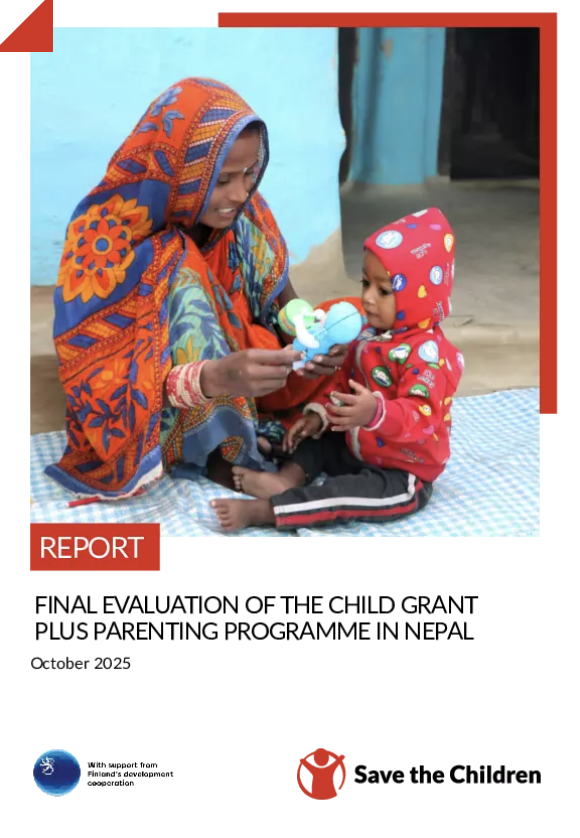
The evaluation of the Child Grant Plus Parenting Programme in Nepal was completed and published in 2025, with very encouraging results.
Link to the study:
https://resourcecentre.savethechildren.net/document/final-evaluation-of-the-child-grant-plus-parenting-programme-in-nepal-2025
Abstract:
The Child Grant Plus (CGPLUS) Parenting Programme is an innovative addition that builds on the success of the national government’s Child Grant cash transfer program in Nepal. By combining Save the Children’s expertise in implementing intensive parenting support, the CGPLUS program was designed to empower parents and caregivers with the skills enabling them to transform everyday moments into opportunities for learning, social-emotional development, and improvements in their wellbeing.
The framework used in the CGPLUS program built on lessons learned form the International Child Development Programme (ICDP) framework. Specific activities guided participating parents through group sessions, home visits, and follow-up support. The goals of the program were to foster nurturing caregiver-child relationships, the use of positive discipline strategies, and improve child nutrition and feeding practices. Animated videos, interactive voice messages, and game-based “brain-building” modules reinforced key lessons between sessions—helping families sustain change far beyond the training room.
Study Overview
This evaluation, conducted across three rounds of data collection between 2022 and 2025, used a quasi-experimental difference-in-differences design to estimate the impact of the CGPLUS programme on a range of caregiver and child outcomes. The study compared results in seven intervention municipalities with six matched comparison municipalities in both rural and urban areas of Madhesh and Karnali provinces. The study followed more than 900 caregiver–child pairs to measure changes in parenting attitudes, behaviors, child feeding and nutrition, and early childhood development outcomes.
Methodology
Data were analyzed using a rigorous difference-in-differences approach, controlling for household, caregiver, and community characteristics. Instruments included the Early Parenting and Attitudes Questionnaire (EPAQ), WHO infant and young child feeding indicators, and the Caregiver-Reported Early Development Instruments (CREDI) for developmental outcomes.
Results
The CGPLUS programme was found to have strong, positive results that were both statistically and practically significant across several types of outcomes.
1. Stronger Parenting Attitudes, Behaviors, and Engagement with Children
CGPLUS achieved major success in improving parenting quality. Caregivers in the intervention group demonstrated impressive gains in warmth, affection, and attitudes towards early learning. By endline, nearly every parent in CGPLUS endorsed positive attachment and stimulation behaviors.
Parents benefiting from the CGPLUS programme also reported substantially higher levels of engagement and stimulating activities. Parents in the intervention group reported higher levels of playing with their child, storytelling, and teaching activities, and nearly all positive behaviors were stronger in the intervention group The programme also appears to have had a meaningful impact on parental use of discipline—parents in the intervention group reported lower levels of psychological aggression, and neglect, and marked improvements in their use of positive discipline.
2. Improved Use of Feeding Practices and Evidence of Improved Nutrition
Parents in the CGPLUS intervention reported improved usage of positive infant and child feeding practices, resulting in children benefiting from improved dietary diversity and meal frequency. Indicators related to overall nutritional status remained below international reference averages for children in both intervention and comparison groups. Intervention children were less likely to be stunted or underweight, suggesting that the behaviors and attitude changes encouraged by the CGPLUS programme translated into real changes in child nutrition and growth.
3. Remarkable Developmental Gains
Perhaps the most striking finding was in child development. By endline, CGPLUS children scored more than one full standard deviation higher on overall developmental measures compared to their peers—an exceptional effect size for education and early childhood interventions. The largest improvements were seen in cognitive and social-emotional domains, suggesting that consistent caregiver interaction and play translated into real developmental progress.
Conclusion
The overall finding of the evaluation is that the program was effective at nearly each one of its goals. These impressive findings are likely driven by a very intensive approach to intervention with close monitoring and support for caregivers. Future work should look to build on the success of the program and explore the viability and efficacy of scalability when intensive interventions are not practical.