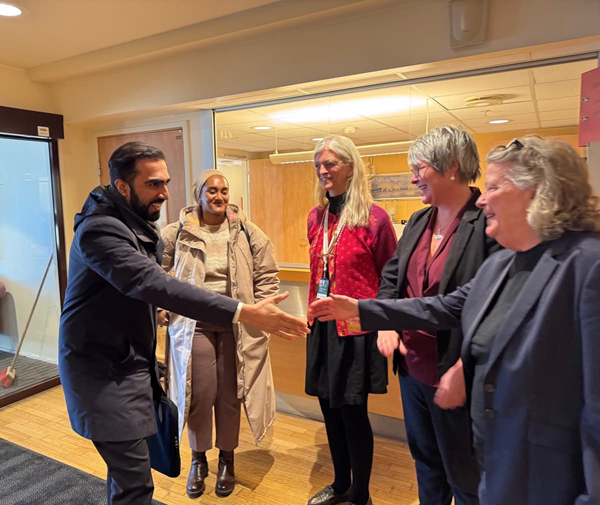
On Tuesday 24 February, 2026, ICDP Norway invited State Secretary Usman Mushtaq (on far left on photo above; photo by Klaus Holthe) to visit Grefsenhjemmet to learn about experiences and research on the effects of using ICDP in nursing homes. He was accompanied by Tamina Sheriffdeen Rauf from the Oslo City Council. Representatives from Oslo Municipality, Haraldsplass Diakonova, Fagskolen Diakonova, the Adult Education Services, the Norwegian Institute of Public Health, VID Specialized University, Grefsenhjemmet and Økernhjemmet also participated. Photo above by Klaus Holthe. The meeting was opened by Heidi Westborg Steel, Managing Director of ICDP Norway, who highlighted that ICDP may offer a practical solution for achieving person‑centred care in everyday practice.
Adapting ICDP for Elder Care: Research Findings and Ongoing Initiatives
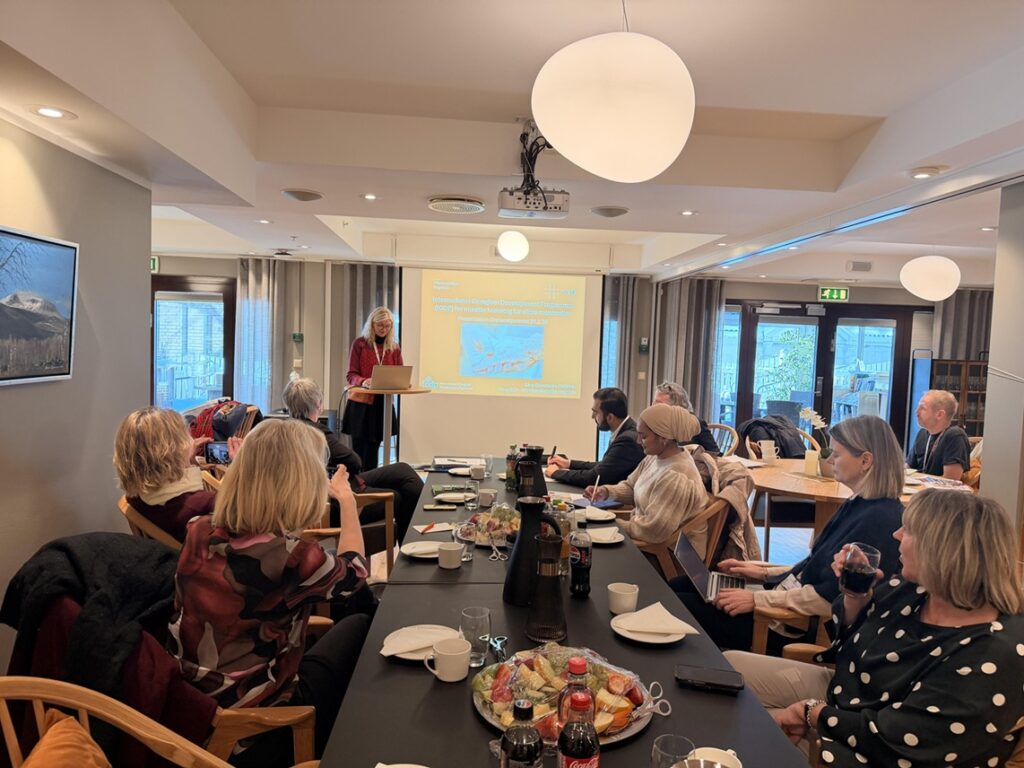
Photo by Ane-Marthe Solheim Skar, showing Line C Holmsen presents her PhD work on ICDP in nursing homes
PhD candidate Line Constance Holmsen from VID presented findings from her doctoral research, in which she adapted the International Child Development Programme (ICDP) for use in elder care (International Caregiver Development Programme; ICDP). The results show that the programme strengthens person‑centred care and provides staff with a shared language and improved tools for psychosocial work. ICDP, delivered in small groups with a focus on reflection and mastery, has increased employees’ confidence, improved Norwegian language skills and strengthened professional communities. Staff report calmer residents, greater confidence, reduced need for medication—and some units have had periods without sickness absence during implementation.
At Grefsenhjemmet, 70 employees have completed ICDP training since 2019. At Økernhjemmet, around 45 employees have completed the programme. Fagskolen Diakonova announced that they are now developing a 15‑credit course that includes ICDP facilitator training and project management.
Experiences from Grefsenhjemmet
Grefsenhjemmet shared experiences showing how the method is naturally integrated into daily work and practice. The manager at Grefsenhjemmet, Julie Mittet, emphasized that ICDP can be practiced without fluent Norwegian, making it particularly relevant for multicultural teams. Employees said the programme has made their work easier, commenting for example: “I have started seeing the person and not just the disease” and “I reflect more on how I work.” Leaders and staff were clear that ICDP does not require more time—instead, it helps save time and encourages a different understanding and use of time, enabling more sustainable implementation.
International Perspectives and Evidence Needs
ICDP trainer Eli Østberg described the programme’s eight themes as “the new medicine.” Internationally, ICDP is referred to as a “vaccine against violence,” and Ane‑Marthe Solheim Skar from the Norwegian Institute of Public Health and the international ICDP board noted that the results, based on robust qualitative data, are already generating international interest and are being used as inspiration in Colombia, where the child version of ICDP has reached tens of millions of people. Skar emphasized the need for scale‑up combined with research on effectiveness and implementation outcomes for both residents and staff, including work environment, sickness absence, medication use and time allocation.
Government Reflections and the Way Forward
State Secretary Mushtaq highlighted the government’s ambition for services that see the individual across the life course, and reflected on how ICDP could be expanded on a larger scale. “Change is difficult, but this is common sense – what I wonder is why this has not spread further already?” he asked, while also encouraging a shift to a more positive narrative: from “ageing wave” to “ageing strength.”
The meeting concluded with a shared understanding that ICDP is an important tool for enhancing quality in elder care by developing and elevating the inherent caregiving competence of health care workers and unskilled staff. ICDP Norway will follow up on this work in light of the recently allocated “elder care uplift” funding in the national budget, with the aim of further scaling, systematic research and strategic anchoring in both education and services.
report by Ane-Marthe Soheim Skar